|
|
|
|


|
The
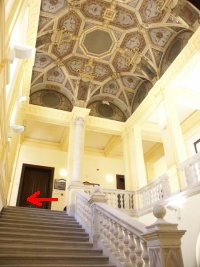
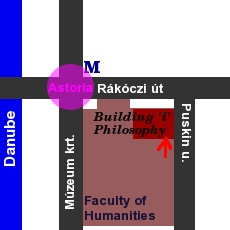
seminar is held in hybrid
format, in person (Múzeum
krt. 4/i Room 224) and
online at the following
link:
|
| 10
April (Friday) 4:15
PM Room 224 + ONLINE
|
Gergő
Gila
|
|
Department
of Logic, Institute of
Philosophy,
Eötvös Loránd University,
Budapest
|
| |
Linguistic
Meaning and the Unconscious
|
|
A
central element of Grice’s
theory of language is that
linguistic meaning is
intention-driven. The
creation and calculation of
speaker meaning depend on
the speaker’s intentions. In
contrast, a central and
fundamental concept of
traditional psychoanalysis
is the unconscious, that
part of the mind to which we
have no primary or
privileged access; indeed,
its content is not even
given to us as a conscious
mental state. Furthermore,
these theories assert that
unconscious processes
influence the processes that
appear in consciousness, and
that through psychoanalytic
work, the analyst can
uncover unconscious contents
by examining linguistic
utterances. The
psychoanalytic concept of
the unconscious has been
subject to criticism based
on numerous considerations
in the philosophy of
science; however, the
results of recently
published research show that
there are indeed motivated
slips of the tongue that
alter the content of the
slip according to the
stimulus presented to the
subject, so it can be
assumed that not all
theories of the unconscious
are entirely without
foundation. I do not wish to
commit to any particular
theory of the unconscious at
this time; my goal is to
examine how the role of
unconscious mental contents
in meaning-making can be
reconciled with a generally
Gricean theory, in which the
speaker’s intentions
determine linguistic
meaning. The question is
whether we have unconscious
intentions that participate
in meaning-making, or
whether mental contents
other than intentions can
also participate in
meaning-making? In the
latter case, does this
possibility apply to
conscious mental contents as
well, or not? The aim of my
presentation is to provide a
detailed explanation of
these claims, as well as to
offer a brief comparison of
the methods of Therapeutic
Discourse Analysis—which
diverges from the Gricean
tradition but draws on
psychoanalytic
literature—with Gricean
theory, and to highlight
potential points of
convergence. |
|
| 17
April (Friday) 4:15
PM Room 224 + ONLINE
|
| Klaus
Kellerwessel
|
|
Department
of Logic, Institute of
Philosophy,
Eötvös Loránd University,
Budapest
|
| |
The
Restless Mind – A Story of
Cognitive Becoming
|
What makes a
system cognitive rather than
merely adaptive? Where should we
draw the boundary between simple
responsiveness to environmental
change and genuine cognition? Must
cognition be tied to
paradigmatically human capacities
such as language, tool use, or
self-awareness, or do even the
simplest living systems
instantiate minimal forms of it?
The issue is not merely
terminological: how cognition is
defined fundamentally shapes our
understanding of learning,
evolutionary processes, animal
minds, and humanity’s place within
the natural order. Definitions
that are overly restrictive risk
obscuring non-human forms of
intelligence, while overly
permissive accounts threaten to
broaden the concept to the point
of explanatory uselessness.
This presentation proposes a
theoretically robust framework for
minimal cognition grounded in
experience-based predictive
modelling and in two embodied
expectations: an inductive
expectation that the future will
resemble the past, and a sceptical
expectation that it will not do so
perfectly. It further argues that
these predictive dynamics are
recapitulated across levels of
biological organization, emerging
both in evolutionary processes at
the population level and in
learning processes within
individual organisms.
|
|
| 24
April (Friday) 4:15
PM Room 224 + ONLINE
|
| Zsófia
Zvolenszky
|
|
Department
of Logic, Institute of
Philosophy,
Eötvös Loránd University,
Budapest
|
| |
Varieties
of artifactualism and the
process of making a
fictional character
|
In
my talk I’ll outline a
proposal about the process
of making a fictional
character that I argue
provides a superior response
to two challenges:
(1) If created,
then “how (and when…)
are fictional characters
created?” (much
discussed since Stuart
Brock formulated the
challenge in his “The
creationist fiction: The
case against creationism
about fictional
characters”, Philosophical
Review, 2010).
(2) If one opts
for artifactualism about
fictional characters,
analogous arguments
motivate artifactualism
about LeVerrier’s Vulcan
as well. (See, for
example, Nathan Salmón’s “Nonexistence”, Noûs, 1998; also, Braun,
Caplan). I put this in
slogan form: “The
artifactualism train
runs express only”.
This will
be a – hopefully smooth
– train ride, starting
with (1), culminating
with a response to (2).
What if you
want to get to a certain
local train stop and are
told that no local
service is running to
that destination;
meanwhile the express
trains you could board
take you way further
than you had planned?
It’s well to choose the
train ride only if you
are in a position to
embrace the express stop
available. This is the
situation that has
recurringly been
confronting philosophers
over the past half
century with respect to
one form of realism
about fictional
characters (FCs): artifactualism, according to
which FCs are non-concrete
human-made objects, that is, non-concrete
artifacts. Various
influential arguments
suggest that
FC-artifactualism is an
unavailable local stop
on the artifactualism
train which offers
express service only.
Once on board that
train, it inescapably
wizzes one to a
further-away express
stop: artifactualism
about the posits of
failed scientific
hypotheses like
Babinet’s and
LeVerrier’s hypothetical
planet Vulcan. Some
philosophers, among them
Nathan Salmón, David
Braun, Ben Caplan, have
embraced that
destination point.
Others, among them
Stuart Brock, cautioned
to stay off the
artifactualism train
altogether.
Can we
instead find the elusive
local train and
disembark at a local
stop without taking a
stance on artifactualism
about the likes of
Vulcan? I will argue
that we can and have
strong reasons to do so.
Though the task is
especially challenging
in the light of a
phenomenon I had
discussed in prior
papers: I envisioned
a (contrary
to fact) scenario T in which Tolstoy, while
writing War and
Peace, “was under
the mistaken impression
that the protagonist,
Prince Bolkonsky, like
Napoleon (also featured
in the novel), was a
real person. Introducing
the name ‘Andrei
Bolkonksy’, Tolstoy
intended to refer to a
historical figure he
thought existed quite
independently of his
novel” (Zvolenszky 2016,
“Fictional characters,
mythical objects, and
the phenomenon of
inadvertent creation”, Res Philosophica). If one is an
artifactualist about FCs then in T, due
to Tolstoy’s error, his
novel-writing activity
launched an FC-making
process whose outcome
was a new FC, Andrei
Bolkonsky. Crucially, in T, Tolstoy’s
process-launching was
unintended, inadvertent.
I had argued that such
inadvertent authorial
launchings are unmysterious
and even expected given
Saul Kripke’s general
arguments (in his 1970 Naming and Necessity lectures) about
name-users’ potential
error that can, on occasion,
afflict authors as well.
The process-launching aspect of FC-making is
a new development on my
prior work. In my talk I
will argue that authors
as launchers who need
not complete the
process, is a plausible
stance according to
which making FCs can be group-projects on occasion in the
context of novels. And
even regularly in the
context of other types
of works of fiction, for
example, when, in the
context of making films,
comics, a fictional
character is created
(examples prominently
discussed in Chris
Tillman & Joshua
Spencer’s 2023,
“Creature features:
Character production and
failed explanation in
fiction, folklore and
theorizing”, Canadian
Journal of Philosophy).
Yet this process and
group-project aspect has
been ignored and
deemphasized in the
literature, which has
instead focused on a solo-act model
of FC-making, with
authors single-handedly
making FCs. This
solo-act focus affects
even local-train-seeking
artifactualists like
Kripke (in his 1973 Reference and
Existence lectures)
and more recently,
Tillman&Spencer
(2023), but is
especially prominent in
Brock’s (2010) arguments
against
FC-artifactualism. Along
the way, I’ll raise
various considerations
about philosophical
methodology that allow
for artifactualists to
shift away from the
solo-act focus and
provide better responses
than before to various
challenges, including
(1) and (2).
|
|

|
|
|